
What does it actually take to ensure that every child — no matter where they live in Sweden — is met by confident leaders and a positive football environment?
We sat down with Carola Söberg, Head of Education, and Elias Mineirji, Head of Development, at the Swedish Football Association. The conversation quickly moved from structure and organization to something bigger: learning as a critical factor in keeping both Swedish football — and Sweden itself — moving forward.
.jpg)
A movement powered by everyday life
Swedish football is one of the country’s largest grassroots movements. But unlike how it is often portrayed, it is not primarily about elite competition or national teams. It’s about everyday life in clubs across the country.
Within the Football Development Department, several teams work in parallel with player development, education, and support for the regional districts. Much of the work happens not only centrally, but also out in the field, close to the day-to-day reality of the sport.
“We work more directly with the districts, who in turn support the clubs,” Elias explains. “We have many people working out in the field, meeting coaches and clubs where the actual work happens.”
That means educational initiatives need to function across multiple levels at once. Centralized content has to feel locally relevant. Strategies need to work in practice. And everything has to stay connected, despite very different local conditions.
This becomes especially clear when discussing geography.
“Should a coach in Lycksele have to travel to Luleå or Umeå for training? That’s a pretty long trip,” says Carola.
What might be a simple commute in a major city can become a major undertaking in other parts of the country. That affects both participation and access to education.
Accessibility therefore becomes more than just a practical issue — it becomes a key factor in creating equal opportunities.
When structure starts to matter
For a long time, education in sports has relied heavily on in-person sessions and printed materials. That approach has worked, but it has also had its limitations.
Logistics are part of the challenge. Carola and Elias describe how the scale can become overwhelming.
“Imagine eight books per participant in a training program, and then multiply that by 10,000,” says Elias.
But the challenge is not only practical — it’s pedagogical as well.
Earlier digital solutions often lacked a clear structure. It could be difficult to understand progress, know what mattered most, and see how different parts connected.
“There was no clear learning path. You clicked around and could easily lose track of where you were,” says Carola.
Creating a clearer structure has therefore become a central part of the development work. A thoughtfully designed learning journey makes it easier to navigate, build understanding step by step, and actually complete the training.
It also opens the door to something that came up repeatedly during the conversation: the opportunity to use different learning formats more intentionally.
A shift in perspective
Perhaps the biggest change is not about technology or structure, but about adopting a new mindset.
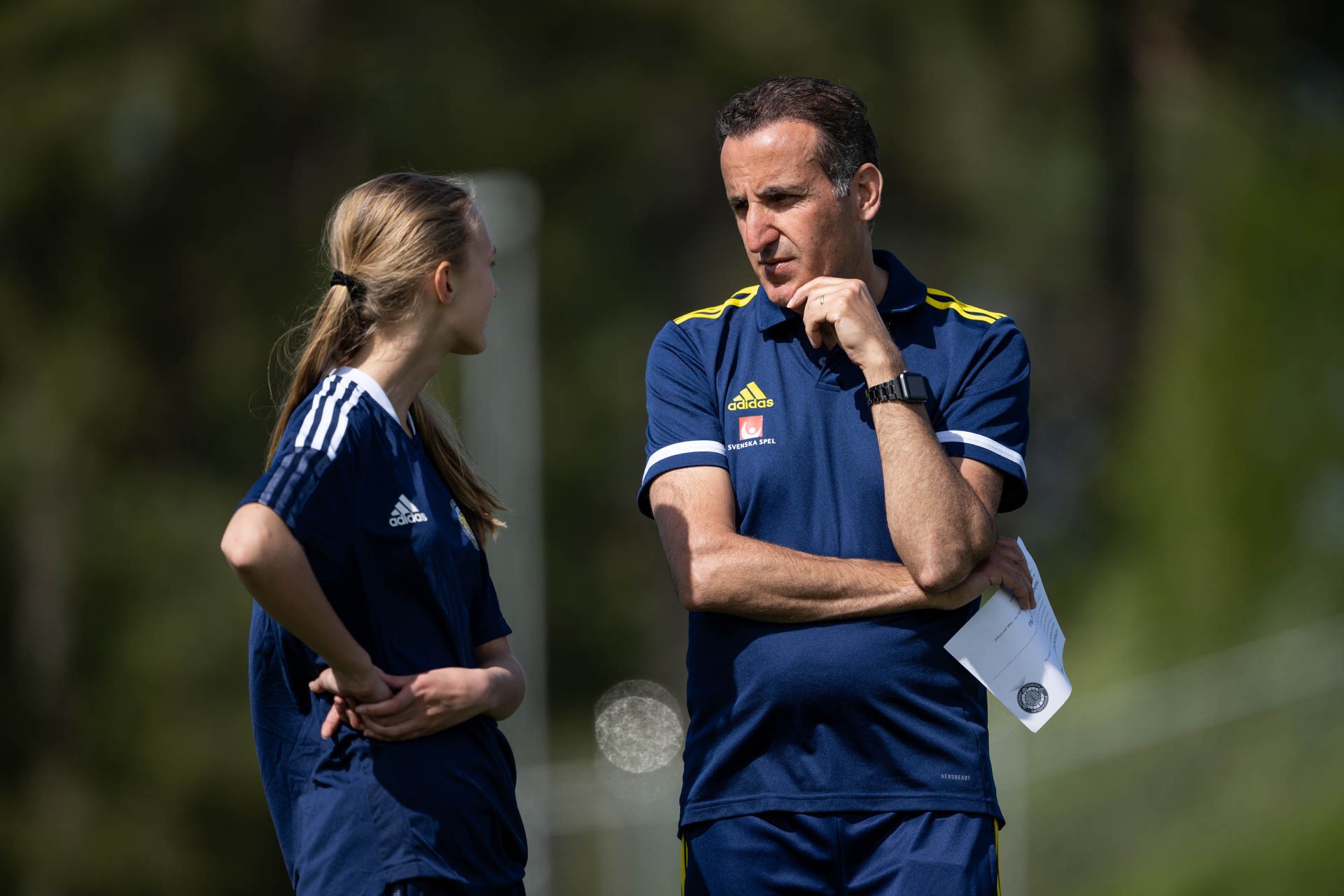
Most people taking these courses are not professional coaches. They are parents volunteering their time — people stepping directly from work and daily life into a leadership role.
That places entirely different demands on how education is designed.
“They’re coming from work, heading to practice, and trying to plan everything in between. Reaching them is always the hardest part,” says Elias.
This has led to a clear shift: from education happening on the organization’s terms to education working on the learner’s terms.
“How can we offer education on their terms? In between cooking dinner, school pickups, and everyday life.”
It’s not only about flexibility in timing, but also about relevance. The content needs to be immediately useful. The structure needs to be easy to follow. And support needs to remain available even after the course is completed.
Because in reality, the difficult situations don’t happen during the training course — they happen out on the field, in real life.

When learning creates real impact
When discussing the scale of the educational efforts, one number stands out: around 10,000 coaches completed the introductory training program in a single year.
But that’s only the beginning of the story.
“All of our training programs should have an impact on every single player,” says Elias.
Every trained coach meets children every week. And around every child are more people — parents, siblings, and other adults.
The impact of learning spreads outward.
“Then we’re talking about millions,” he continues.
That means football education is also about values and behaviors. How you lead. How you communicate. How you create an environment where children want to continue playing.
And that leads directly into one of the most important questions moving forward.
Eliminating the “safety lottery”
One phrase came up several times during the conversation: “the safety lottery.”
It describes something many people recognize — that a child’s experience in sports can vary dramatically depending on which coach or leader they happen to get.
That’s exactly what the Swedish Football Association wants to change.
“It shouldn’t be a lottery for children what kind of environment they end up in,” says Carola.
“We have a responsibility to make sure everyone working with our children has access to the right tools and a strong foundation of values. Perhaps even ensuring that everyone completes targeted training.”
At its core, this is about creating a shared standard — a minimum level that ensures more children have a positive experience, regardless of where they are.
The next step: Becoming even more responsive
When we ask Carola to look ahead, her answer is clear. The focus is not on building more, but on becoming better at prioritizing the right things.
“We’ve established a strong structure and a solid foundation. The next step is continuing to develop by listening even more carefully to the needs out in the field. What we prioritize should create real value in everyday life.”
That also means continuing to refine how different formats are used.
“When should something happen in person? When does digital work best? And when is a hybrid solution the right approach?”
There is no universal solution. Different audiences, different situations, and different parts of the country require different approaches.
“Different formats have different strengths, and our job is to use them where they create the greatest value and the strongest learning impact — the kind that drives lasting behavioral change.”
That’s where education stops being something you simply “do” and starts becoming something that genuinely changes people.

Where it all begins
As we wrap up the conversation, we end up back where it really started. Not with structures, systems, or formats — but with everyday life.
- With children looking forward to their next practice.
- With leaders who feel confident in their roles.
- With environments where it’s fun to belong.
That’s where Swedish football keeps moving forward.
And it all begins with giving the right support to the people at the center of it every single week.
In this post
The complete solution for impactful learning
See how Learnifier can help you align learning with your business goals and understand how your people learn best.

Curious about course creation?
Try Learnifier for free and start building your own courses today.
Explore Learnifier in action
Try our intuitive, user-friendly platform for onboarding, training, and knowledge sharing.
.webp)
Build scalable onboarding
that works
Create engaging programs that deliver results – with less manual work.
Simplify compliance management
Create certification programs, automate follow-ups and reporting – all in one platform.