Measuring Training and Learning ROI

Measuring ROI is one of the biggest challenges in learning and development. Whether you are evaluating compliance training ROI, sales training ROI, customer training ROI, or the overall learning and development ROI, the question is the same: how do training initiatives translate into real behavioral change and measurable business impact?

The Learnifier Learning Pyramid provides a structured way to measure training and learning ROI — from motivation and engagement to results and return on investment.

Why don't more organizations measure their education?

22%

Don't know how/lack internal knowledge

52%

No one asks for results

16%

Fear of negative results

9%

Other

60-90% of all educational efforts go to waste

Phillips, J. J., & Phillips, P. P. (2017). The business case for learning (s.29)

Follow-up leads to impact

Effective follow-up creates a clear connection between learning and organizational development.

Nearly all business leaders (98%) demand clear, measurable impact from investments in competence development.

When participants see that their efforts deliver results, both motivation and willingness to continue developing increase.

Learnifier Learning Pyramid

With our learning pyramid, you ensure that learning doesn’t just happen - it delivers measurable results linked to business objectives.

How does the pyramid work?

The learning pyramid helps you create engaging and effective training by, step by step, identifying what’s required to increase completion rates and measure real impact. It shows where you are in the process and how to improve learning to ensure training is relevant, value-creating, and aligned with business goals. Try our learning pyramid and maximize the impact of your training.

Motivation

By meeting participants’ needs and expectations, you create the foundation for engaging and effective training that leads to real results.

  • Identify the drivers and the need for the training
  • Understand your target audience
  • Find intrinsic motivation – personal interest
  • Use extrinsic motivation – set clear expectations and requirements
  • Meet expectations
  • Present clear consequences of knowledge gaps
  • Surveys/pre-study – How important is it for you to handle employment law matters correctly in your role?
  • Self-assessment test
  • Interviews
  • Indicators of clear value creation and a willingness to put knowledge into practice.
  • Reinforce through immediate application, feedback, and recognition.
  • Encourage through mentoring, follow-up, and rewards.
  • Analyze and adapt — content, format, relevance, or support.
  • Create a clearer connection to roles, needs, and development.
  • Ensure support and encouragement for applying learning in everyday work.

Engagement

An engaging training design leads to more satisfied participants and increases the likelihood that they apply their new knowledge in practice, creating long-term value for the organization.

  • Allocate time for the training
  • Ensure a consistent and visually appealing design
  • Make the training interactive
  • Use reflection questions
  • Ensure the training is time-efficient and appropriately challenging
  • Ensure theoretical content can be applied in practice
  • Link each section to the learning objectives
  • Observation – How many participants appear engaged?
  • Interviews
  • Attendance
  • Self-assessment
  • Report statistics – Where do participants get stuck?
  • High engagement indicates that the training is relevant, motivating, and closely aligned with participants’ needs.
  • Build on this by creating opportunities for application, reflection, and continued development.
  • Identify the causes of low engagement through participant feedback and follow-up.
  • Adapt the training content, format, and delivery to better meet the needs of the target audience.
  • Strengthen interactivity, practical application, and support structures to increase motivation and participation.

Reaction

Evaluate quality and delivery by gaining insights into how the training was delivered and how participants experienced it. These insights provide a solid foundation for further analysis and improvement.

  • Make the training satisfying, relevant, and practically applicable.
  • If motivation and engagement are in place, this will lead to a stronger positive reaction.
  • Feedback
  • Evaluation
  • When participants are satisfied with the training, the conditions for applying learning in practice are significantly improved.
  • A positive experience strengthens motivation and increases the likelihood of behavioral change and continued competence development.
  • Analyze participant feedback to identify areas for improvement.
  • Adapt content, methodology, and structure to increase relevance and engagement.
  • Ensure the training meets participants’ needs and creates value for both the individual and the organization.

Learning

The true value of training emerges when knowledge is translated into insights and actions that drive change. What skills and insights do participants take away from the training? How does it affect their work and decision-making?

  • Identify the knowledge, skills, and attitudes participants take away from the training.
  • If motivation, engagement, and reaction are in place, this will result in a high level of learning.
  • Pre- and post-tests
  • Role play
  • Presentations
  • Reflection questions
  • When participants have developed both knowledge and skills, strong conditions are created for applying learning in practice.
  • The next step is to ensure application through support, follow-up, and continued competence development.
  • Analyze knowledge gaps and adapt learning methods to increase learning effectiveness..
  • Strengthen the training through more interactive learning, repetition, and practical exercises.
  • Ensure participants receive the right support to reach the level required to apply knowledge in their work.

Behavior

It is only when learning leads to new ways of acting in everyday work that it creates real impact. Learning becomes meaningful when it changes how we think and act in working life — but how do we know if such a change has occurred?

  • Cognitive – how we solve problems, think critically, or make decisions.
  • Social – communication, collaboration, leadership.
  • Operational – following a new work process, using a new system.
  • Observation
  • Self-assessment
  • Statistics / KPIs
  • Follow-up meetings
  • Problem-solving
  • When training results in clear behavioral changes and improved performance across the organization, the initiative can be scaled and integrated into strategic processes.
  • Build on this success by reinforcing learning through further development and deeper capability building.
  • Adapt or redesign the training to increase practical application.
  • Strengthen organizational support through repetition, workshops, and follow-up meetings.
  • Ensure participants have the right conditions to translate knowledge into action in their day-to-day work.

Result

Evaluating results shows how training contributes to organizational goals and justifies continued investment. Through measurable KPIs, follow-up, and data analysis, we can ensure real business value.

  • Direct effects
  • Indirect effects
  • Key performance indicators (KPIs)
  • Comparison over time
  • Productivity metrics
  • Customer-related metrics
  • Efficiency and cost savings
  • Employee engagement and performance
  • When training contributes to business objectives and creates measurable value, it can be scaled and further developed.
  • Successful impact strengthens the case for future investments in learning and competence development.
  • Adapt or redesign the training to better meet the organization’s needs.
  • Support the business by providing the right tools, methods, and support structures.
  • Ensure learning remains relevant through continuous updates in line with societal developments and industry trends.

ROI

By calculating ROI, we can compare the costs of training with the financial benefits it has generated. This may include increased revenue, reduced costs, or improved efficiency.

  • Costs such as resources, training materials, and travel
  • Gains in the form of increased revenue, reduced costs, and improved efficiency
  • ROI = ((Gains − Costs) / Costs) × 100
  • The training has delivered impact and can be used as a strong example for implementing similar initiatives and justifying further investment.
  • Conduct a 'lessons learned' analysis of the entire training initiative to identify insights and maximize value from a new perspective.

The Pyramid in Practice

Now that we’ve gone through each level, let’s look at how you can use the entire Learning Pyramid in practice.

Create a training strategy

Start by designing your training from the top down, structuring the content strategically.
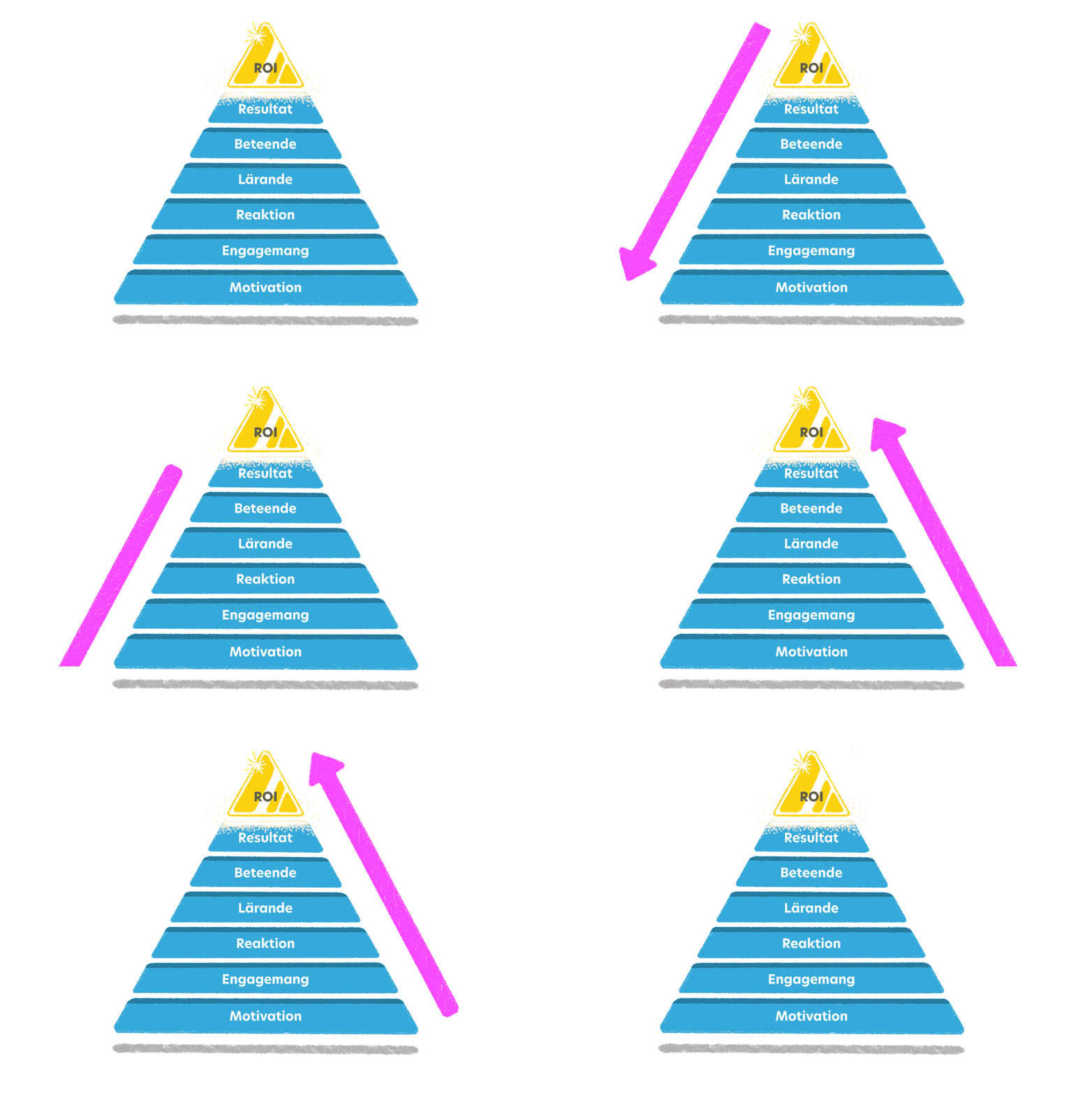
Deliver training aligned with your strategy

Deliver the training from the bottom up to ensure both understanding and long-term learning.