
.avif)

Starting a new job should feel exciting - not overwhelming. Yet for many employees, the first weeks are filled with uncertainty, unanswered questions, and unnecessary friction. That’s where onboarding makes all the difference.
Employee onboarding is far more than a welcome meeting or a checklist of tasks. It’s the foundation of the employee journey - shaping how quickly new hires become productive, how connected they feel to the organization, and ultimately whether they choose to stay.
In this guide, we explore what onboarding really is, why it’s critical for both people and performance, and how modern organizations use digital onboarding and preboarding to create a strong start. Along the way, we’ll share up-to-date research, real customer examples, and practical insights on how platforms like Learnifier help organizations scale onboarding without losing the human touch.
If you’re looking for quick answers, you can also jump straight to our FAQ section at the end of this guide.
What is employee onboarding?
Employee onboarding is the structured process of welcoming, training, and integrating new hires into an organization. It helps employees understand their role, tools, expectations, and company culture - so they can contribute with confidence as quickly as possible.
At its core, onboarding is about turning a new hire into a fully engaged team member. That means combining practical elements like access, policies, and role-specific training with human elements such as belonging, purpose, and connection.
And importantly: onboarding does not start on the first day at work. It begins the moment a candidate signs their contract.
Onboarding vs preboarding - what’s the difference?
Onboarding and preboarding are often mentioned together - and for good reason. They are two sides of the same coin, but they happen at different moments in the employee journey.
What is preboarding?
Preboarding refers exclusively to the phase between contract signing and the first day on the job. It’s an early extension of onboarding that prepares, reassures, and engages new hires before they officially start.
This phase is often underestimated. In reality, it’s one of the most powerful opportunities organizations have to build trust and momentum.
Modern employee experience research shows that around 86% of employees decide within the first six months whether they see a long-term future with a company, and nearly one in three consider leaving when expectations and support are unclear (AIHR, 2025). That decision-making process often starts long before day one.
Why preboarding matters
The time between signing the contract and starting the job can easily turn into a vacuum. When communication goes quiet, doubts creep in. New hires may question their decision, or even accept another offer.
Preboarding fills that gap. By sharing information early, introducing the team, and setting clear expectations, organizations reduce risk and create a sense of certainty and excitement before the first working day even arrives. Because preboarding takes place at a moment when expectations, motivation, and attention are at their peak, even relatively small efforts can have a significant effect. There is simply no better icebreaker.
Five benefits of preboarding
In practice, organizations that invest in preboarding typically see five clear benefits:
- Taking advantage of the energy created at contract signing
- Getting administration and paperwork out of the way
- Allowing the organization to get to know the new hire earlier
- Helping the new employee get to know the team and culture
- Paving the way for faster results and long-term commitment
Do employees really want to start before day one?
A common, and relevant, concern with preboarding is whether it makes employees feel pressured to “work for free” before their employment officially begins.
Research suggests the opposite.
One of the most common reasons new employees leave during probation is unclear expectations and insufficient learning support. According to Gallup workplace research, only about 50% of new hires fully understand what is expected of them. However, when managers provide guidance, clarity, and regular check-ins, engagement increases significantly. Among millennials – now the largest group in the workforce – 72% report higher engagement when they receive meaningful support from their managers (Gallup Workplace Reports, 2024–2025).
Preboarding is not about doing the job early. It’s about removing uncertainty, handling administration, and giving people a confident, calm start.
Want to learn more about preboarding? Read our in-depth article on preboarding, including practical checklists and key benefits.
Why employee onboarding is so important
A new job should feel anything but heavy. When onboarding is done right, it becomes the first chapter of a great employee journey - one that benefits both the individual and the organization.
Yet despite its importance, onboarding is still widely underdeveloped. According to Gallup, only about 12% of employees feel that their employer works really well with onboarding. That gap represents a massive, often overlooked opportunity (Gallup Analytics).
Retention and long-term commitment
Strong onboarding has a measurable and lasting impact on retention. Recent global analyses show that employees who go through structured onboarding are up to 82% more likely to stay, and those who feel supported from day one are 69% more likely to remain with the company for at least three years (BuildEmpire, 2025; StrongDM – Employee Onboarding Statistics, 2025).
Brandon Hall Group further reports that a well-designed onboarding process can increase employee retention by up to 82%, reinforcing how decisive those first weeks really are.
In a competitive labor market where top talent has plenty of options, that early experience often determines whether someone builds a future with the company - or starts looking elsewhere.
Engagement and productivity
Onboarding doesn’t just influence whether people stay - it directly affects how well they perform. When employees understand their role, tools, and priorities early, they reach productivity faster and feel more confident contributing.
Research from Brandon Hall Group shows that effective onboarding can boost productivity by more than 70%, making it a clear driver of business performance.
This is one reason why organizations increasingly view onboarding as a strategic investment rather than an administrative formality. It strengthens collaboration, clarifies expectations, and creates alignment across teams from the very beginning.
The cost of getting it wrong
Recruitment is expensive. Across U.S. industries, the average cost of hiring a new employee is around $4,000, excluding lost productivity and the knowledge gaps that come with turnover (Folks HR – Employee Onboarding Cost Analysis, 2024–2025).
With younger employees switching jobs more frequently than ever, weak or inconsistent onboarding quickly becomes a costly pattern rather than a one-off problem.
But the impact doesn’t stop with new hires. Poor onboarding also drains internal resources. HR teams, managers, and colleagues spend significant time repeating introductions, answering the same questions, and handling last-minute issues that could have been prevented with a clear, structured process. That time comes at the expense of focus, productivity, and relationship-building.
In that context, onboarding isn’t just good HR practice. It’s smart leadership and sound business strategy.
Still not sure? Here are 20 benefits of investing in onboarding.

What does successful onboarding look like?
There is no universal blueprint for the “perfect” onboarding program. Every organization is different, and onboarding should reflect its culture, vision, and way of working.
What successful onboarding does have in common is balance. It combines structure with flexibility, clarity with human connection, and consistency with role-specific relevance. It introduces new hires not just to tasks, but to how things are done - and why.
This is also where the right tools make a real difference. With a digital learning platform like Learnifier, organizations can tailor onboarding journeys for different roles, automate repetitive tasks, and ensure that every new hire gets a consistent, high-quality start – without overloading HR or managers.
Physical, digital, or blended onboarding?
Digital transformation is essential for long-term competitiveness. Halfway solutions are no longer enough - and onboarding is no exception. But making onboarding more efficient through digital tools doesn’t mean removing the human element.
The challenge isn’t choosing between physical or digital onboarding – it’s understanding how they work best together.
Why onboarding shouldn’t be only digital
Face-to-face meetings, informal conversations, and physical presence play a vital role in building trust and belonging. Human connection cannot - and should not - be replaced.
Why digital onboarding is no longer optional
At the same time, relying solely on manual, in-person onboarding makes it difficult to scale, standardize, and adapt. Digital onboarding ensures that information reaches the right person at the right time, reduces errors, and frees up time for meaningful interaction.
Blended onboarding: the best of both worlds
The most successful organizations use a blended approach – combining physical interaction with digital structure. In learning, this is often referred to as blended learning.
With platforms like Learnifier, companies can automate administration, host training content, enable communication, and track progress - while still leaving room for personal meetings, mentoring, and culture-building moments.
Automation in onboarding - the rocket fuel
Automation gives onboarding flow. By reducing manual handovers and repetitive tasks, it creates clarity for new hires and breathing room for HR and managers.
Automated onboarding workflows can handle greeting messages, reminders, meeting bookings, feedback collection, and follow-ups - ensuring nothing falls through the cracks.
The result is a more personal, consistent, and scalable experience.
Automation leads to:
- Less administration
- Less workload
- Faster communication
- Faster completion
- Faster results
Results of digital and automated onboarding
Creating a great onboarding experience requires more than good intentions. It takes structure, consistency, and the right tools. By bringing content, communication, and interaction together in one place, digital onboarding makes the journey smoother for both new hires and internal teams.
The impact is tangible. Employees reach productivity faster, every new hire receives consistent information, and engagement levels rise. At the same time, onboarding becomes easier to scale – whether for growing teams, multiple locations, or remote employees – while managers gain better visibility into progress and where extra support is needed. Platforms like Learnifier support this by combining automation, learning content, communication, and follow-up in a single environment, helping organizations save time without compromising quality or engagement.
“Previously, onboarding new volunteers at From One To Another required about 10 hours of individual training. Now, we have streamlined the process to just 3 hours – a 70% improvement – and the volunteer is ready to contribute immediately.”
– Kristina Hagström Illievska, From One to Another
Curious to learn more? Explore our guide on digital onboarding.
Onboarding timeline: what happens when?
Onboarding is a journey that unfolds over time, not a single event. Different stages serve different purposes – from preparation and clarity to performance and long-term engagement. At Learnifier, a dedicated Customer Success Manager helps you structure your onboarding program to save time and avoid common pitfalls.
Preboarding (before day one)
When: From contract signing to start date
Focus: Preparation, reassurance, early engagement
Paperwork, access to tools, essential information, and early introductions help replace uncertainty with confidence before day one.
Orientation (the first days)
When: Day one to the first week
Focus: Context, clarity, belonging
New hires are introduced to the organization’s mission, values, policies, people, and ways of working.
Role-specific training (the first weeks)
When: The first weeks to first months
Focus: Skills, expectations, performance
Employees learn role-specific tools and processes, often supported by clear milestones such as 30-, 60-, and 90-day goals.
Integration and development (ongoing)
When: From the first months onward
Focus: Growth, autonomy, retention
Regular check-ins, feedback, and development conversations help employees settle in, grow, and stay engaged over time.
“As our group started to grow, we quickly realized the need for scalable onboarding. With Learnifier, we bring everything together in one place, automating the process and ensuring that every new employee gets the right training. The result is a structured and safe start—regardless of role.”
– Julia Hanouch, HR Assistant, Pima Gruppen
The five C’s of onboarding
If the aspects above describe the when of onboarding, the 5 C’s framework helps you master the how. These five guiding principles can be applied throughout the journey to make sure every new hires feels supported, aligned, and ready to succeed:
- Compliance – Help new hires understand rules, policies, and procedures so they feel secure and confident from the start.
- Clarification – Set clear expectations around roles and responsibilities to reduce confusion and increase focus.
- Culture – Introduce employees to your mission, values, and ways of working to build belonging and shared purpose.
- Connection – Encourage relationships with colleagues, managers, and mentors to create a strong support network.
- Check-back – Follow up and provide feedback over time to ensure continuous improvement and sustained engagement.
With these five elements in place, onboarding turns into more than a first-day task, it becomes an ongoing investment in people and performance.
Onboarding tips
Small touches can have a big impact on how new hires experience their first days and weeks. Simple actions – like scheduling a casual lunch or video call – help employees feel part of the team right away and keep the excitement alive from the moment the contract is signed.
Other gestures, such as sending a welcome kit, pairing new hires with a buddy, or making the first day feel intentional and celebratory, go a long way in building belonging and motivation. Early check-ins before day one and invitations to social activities also help create connections before work even begins.
For more inspiration, see our article with 23 creative onboarding ideas.
Wrapping up
Onboarding is not just about welcoming new hires, it’s about setting the stage for long-term success. With the right structure, culture, and employee onboarding software, in place, you can turn those first days and weeks into an experience that drives both engagement and performance.
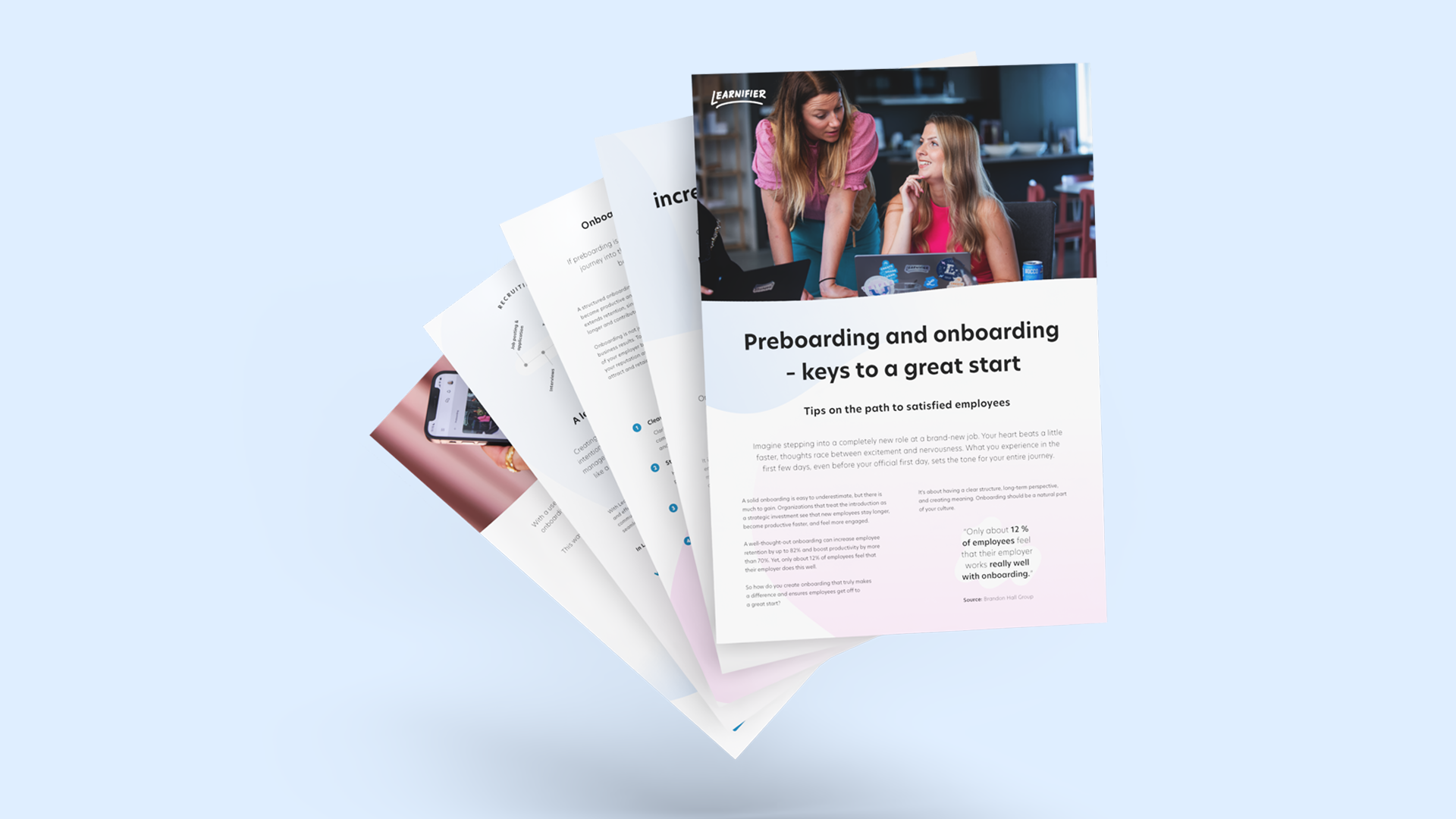
Ready to take the next step? Download our complete Preboarding and Onboarding guide and start building an onboarding journey that truly makes a difference.
Common questions about Onboarding
What is onboarding?
Why is onboarding important?
What is digital onboarding?
How do you measure onboarding success?
How can onboarding be adapted for remote employees?
How does onboarding improve employee performance and workforce retention?
How long does onboarding take?
Onboarding vs. orientation
Preboarding vs onboarding - What's the difference?
What are examples of good onboarding practices?
What are the 5 C’s of onboarding?
What is employee onboarding software?
In this post
The complete solution for impactful learning
See how Learnifier can help you align learning with your business goals and understand how your people learn best.

Curious about course creation?
Try Learnifier for free and start building your own courses today.
Explore Learnifier in action
Try our intuitive, user-friendly platform for onboarding, training, and knowledge sharing.
.webp)
Build scalable onboarding
that works
Create engaging programs that deliver results – with less manual work.
Simplify compliance management
Create certification programs, automate follow-ups and reporting – all in one platform.