
.avif)

Competence development has evolved from a purely HR-driven initiative into a critical business priority. For organizations that want to retain skills, develop their people, and achieve long-term strategic goals, structured competence development is now essential.
Mattias Borg, CEO of Learnifier, has worked with leadership and employee development throughout his career. In the webinar, he shared insights, lessons learned, and concrete examples of how competence development can be designed to deliver real business impact. Below is a summary of the key takeaways. Are you short on time? Here are commonly asked competence and employee development questions.
The labor market places new demands on competence development
The labor market speaks for itself. Recruitment is increasingly challenging, employees change jobs more frequently than ever, and employers are expected to do more to ensure that people stay, thrive, and grow. At the same time, the World Economic Forum estimates that 50% of all employees will need reskilling within the next five years.
“A key to achieving business results is making learning simple, engaging, and effective. Given the changes in the world around us, competence development is more relevant than ever,” says Mattias Borg.
Competence development needs are changing faster than ever
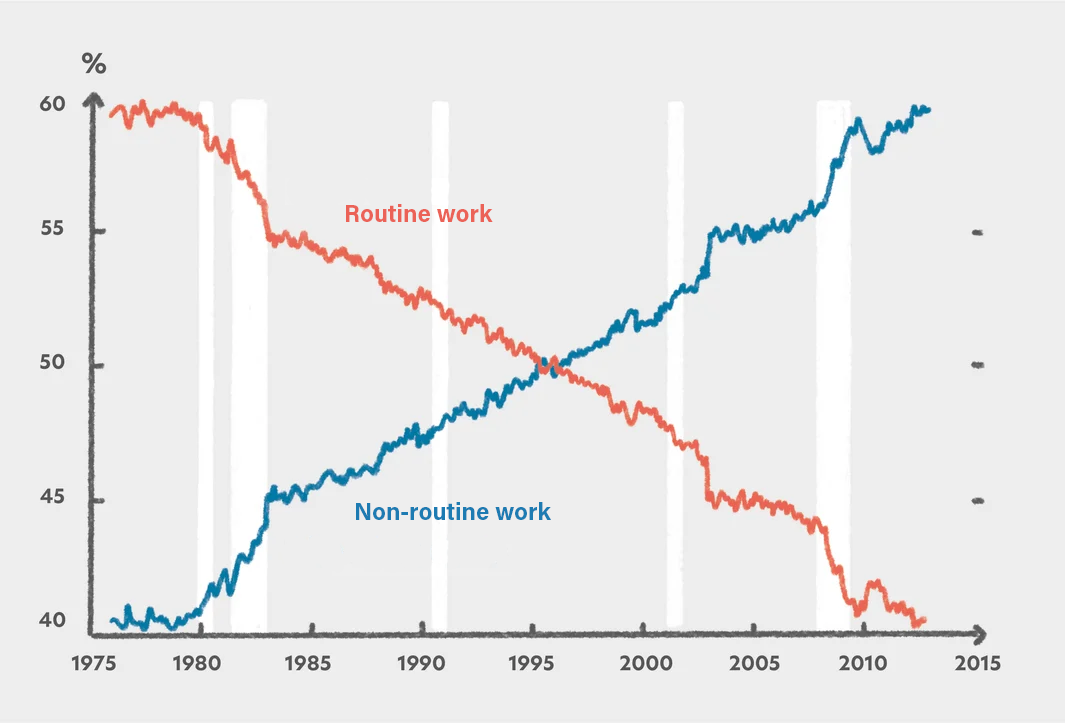
Mattias takes his starting point in the industrial revolutions and illustrates how competence requirements have changed dramatically in recent decades due to digitalization and automation.
“We can clearly see how routine work has been automated away, while the need for non-routine work has increased. As we enter the fourth industrial revolution with AI solutions, while also facing economic uncertainty - competence development requirements will change even faster.”
At the same time, many organizations already face major challenges in their work with employee development. These challenges may include lack of time, insufficient prioritization from leadership, low employee motivation, or uncertainty about how existing learning initiatives should be digitalized.
Human capital – why employee development is a strategic investment
Mattias uses the concept of human capital to describe the value of people’s skills and capabilities within an organization. With the right structure and technology, companies can significantly increase the return on their investments in competence and employee development.
To clarify where organizations typically stand - and where focus should be directed - Learnifier uses a framework with inspiration from the 70:20:10 Institute that divides competence development initiatives into four areas based on HR versus business focus, and operational versus strategic priorities.
Employee development framework
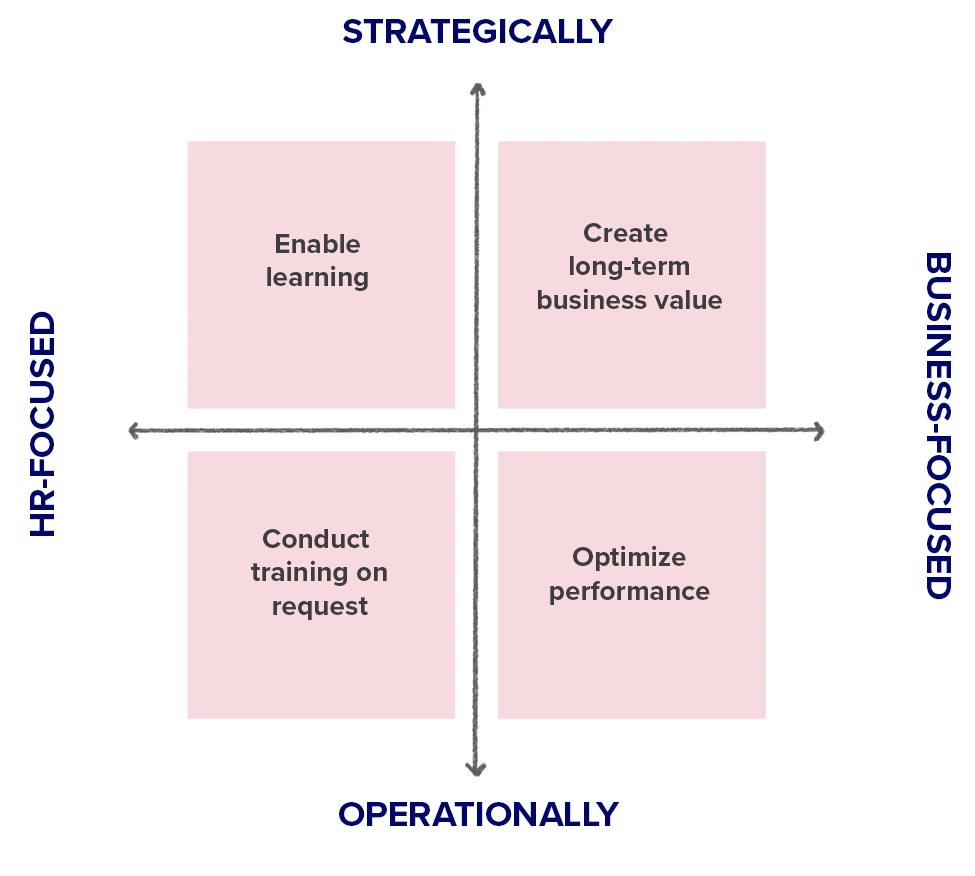
This area focuses on delivering training on demand and ensuring that basic competence requirements are met, such as compliance and mandatory training.
Two key development areas are:
- Digitalization – today, effective digital learning can be produced at relatively low cost
- Automation – administration, follow-up, and communication around training can largely be automated
2. Business-focused and operational
Here, competence development is about optimizing performance. The focus is on learning transfer over time and on measuring impact based on changed behaviors and achieved results - not just participant satisfaction. Much of this work can also be digitalized.
3. HR-focused and strategic
This area focuses on enabling learning within the organization through structure, resources, and accessibility. Examples include learning catalogs where employees take greater responsibility for their own competence development.
Responsibility for development is distributed from HR into the organization, often leading to higher engagement. To create real value, however, both learning capability and learning culture must be developed over time.
4. Business-focused and strategic
This area focuses on creating long-term business value through competence development. An effective approach is to break initiatives down into three steps:
- Start with the outcome – what business value should be created?
- Break it down into skills – which competencies are required to reach the goal?
- Create ownership – involve the organization early and work with pilots
“One way to think about this framework is that the HR-focused areas are about working in the machine, while the business-focused areas are about working on the machine,” explains Mattias.
To achieve effective competence development in organizations, all four areas must work together.
Technology as an enabler of modern competence development
Finally, Mattias emphasizes the importance of using technology to free up resources, create structure, and enable scalable employee development.
“Technology that is easy to use for employees, managers, and subject-matter experts is not the entire solution—but it is a crucial component for creating long-term business value.”
Common Competence & Employee Development Questions
What is employee development?
What is an employee development strategy?
What is competence development?
How can technology support employee development?
What are common challenges in competence development?
Why is employee development important for organizations today?
How is competence development different from employee development?
How should employee development goals be defined to create business value?
In this post
The complete solution for impactful learning
See how Learnifier can help you align learning with your business goals and understand how your people learn best.

Curious about course creation?
Try Learnifier for free and start building your own courses today.

Explore Learnifier in action
Try our intuitive, user-friendly platform for onboarding, training, and knowledge sharing.
.webp)
Build scalable onboarding
that works
Create engaging programs that deliver results – with less manual work.
Simplify compliance management
Create certification programs, automate follow-ups and reporting – all in one platform.

.jpg)