.webp)

“We need to be able to train for what almost never happens”
How do you train thousands of employees, spread across the entire country, around the clock, in one of Sweden’s most safety-critical industries?
At SJ, training is not only a responsibility but a strategic part of the core business. By combining legal requirements, research, VR, 360-degree environments, and pedagogical structure, they have built a modern approach to learning that has become a benchmark in the industry.
In a conversation with Fredrik Lundberg, Learning Developer at SJ, we follow SJ’s journey from traditional training to data-driven, evidence-based, and immersive methods.

Training as part of safety work
SJ’s training operations are governed by legislation and regulatory demands. This means the training must be precise, recurring, and measurable. In recent years, regulations have also shifted focus from theoretical knowledge to practical ability. “We must be able to show that staff not only know what to do but can actually perform it in practice,” Fredrik explains.
As a result, SJ has invested extensively in digital and simulated training formats that create greater realism and accuracy.
It is very clear when training makes a difference. We see fewer uncertainty reports and a completely different level of confidence among participants. These combined effects have led to shorter lead times, fewer incident reports, and a more consistent skill level across the country.
Learnifier as the hub for SJ’s digital training
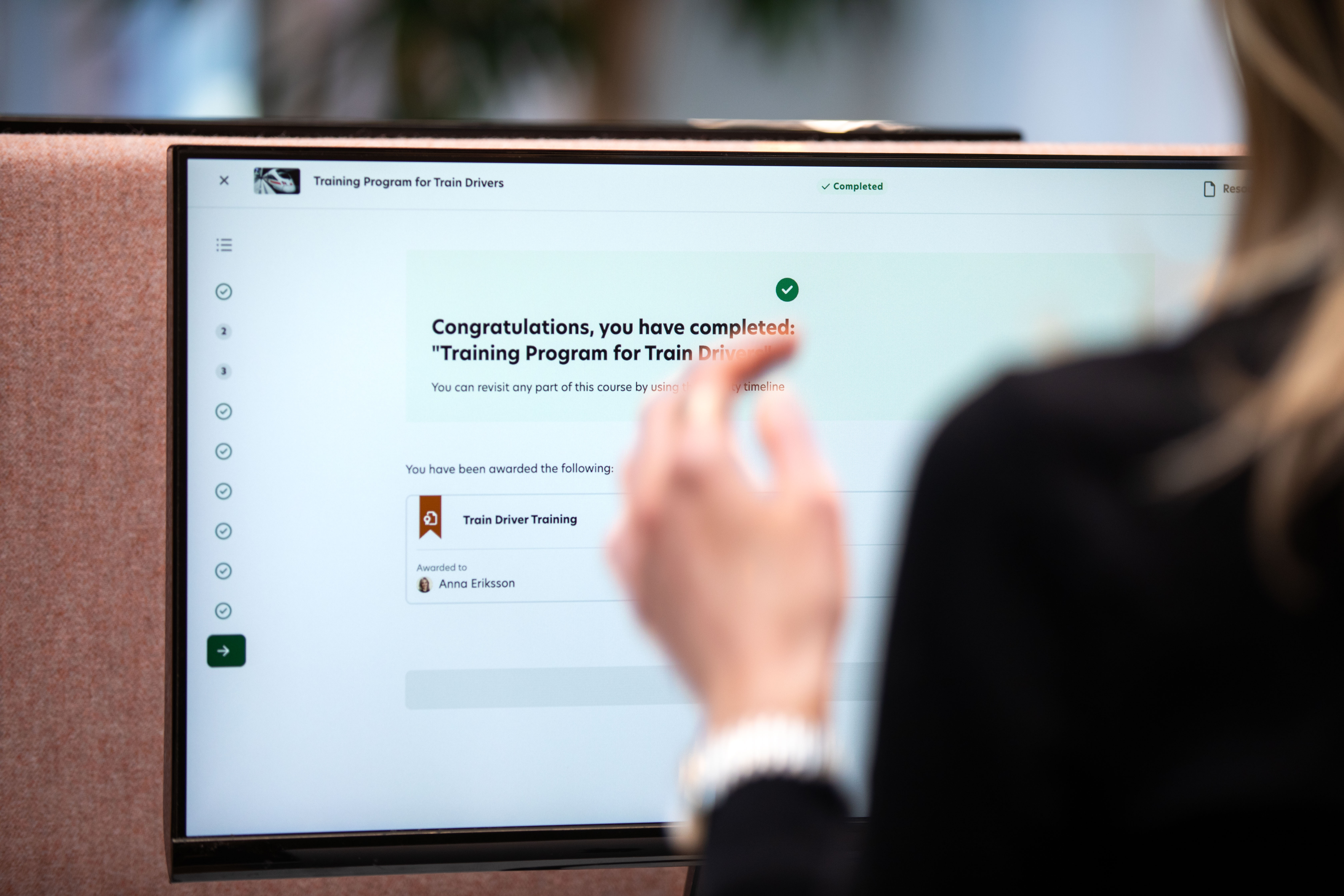
To gather all digital learning in one place, SJ uses Learnifier as its central training platform. Here, employees can access e-learning, course materials, 360-degree walkthroughs, and links to VR exercises in a structured and accessible way.
The collaboration between Learnifier and SJ has deepened over time, in step with SJ’s growing need for scalability, structure, and digital training methods. “Learnifier is the hub where everything comes together. Courses, 360-degree tours, VR links, and all our digital material meet in one place,” Fredrik says.
This enables SJ to maintain consistency even when training involves a wide mix of methods and learning formats.
Technology alone is not the solution – the combination is
SJ uses a broad palette of training methods including VR, 360-degree environments, train simulators, e-learning in Learnifier, micro-learning, videos, and instructor-led sessions. “We learned early on that technology must not lead the way. The training needs must lead the way,” Fredrik emphasizes.
Learnifier plays a vital role in gathering, combining, and making all of these training elements accessible across the entire organization.
VR for conflict management when reality cannot be practiced in reality
Conflict management is an area where classroom-based learning has major limitations. Situations are unpredictable, emotionally charged, and influenced by environment and behavior. To meet this challenge, SJ has developed realistic VR scenarios based on actual incidents.
“There is no answer key when a situation occurs. That is why we need to train our ability to read the situation, adapt, and act with confidence,” says Fredrik.
In VR, participants encounter different types of passengers in various environments, supported by an instructor who appears as an avatar. The scenarios are designed to be as close to real life as possible, down to subtle details such as body language and behavior patterns.
.png)
Research with University West creating evidence for the pedagogy of the future
One of SJ’s most innovative initiatives is its research collaboration with University West, where VR is being studied as a method for training in threat and violence situations. The goal is to understand how VR influences behavior, confidence, learning, and the ability to act in critical moments. “We want to move from believing that VR works to knowing that it works,” Fredrik says.
When the project concludes, the results will be published as scientific studies, making the initiative unique both within the transport industry and within digital learning more broadly.
Fire safety training in VR same weight, less environmental impact
Fire safety training at SJ has also transformed significantly. Previously, all sessions were conducted with the fire brigade using real extinguishers and physical exercises. Today, a large portion of this training takes place in VR, where participants use a physical extinguisher with the correct weight while working in a fully simulated environment.
The system provides detailed feedback on technique, distance, timing, and accuracy. The theoretical preparation is handled digitally, with Learnifier serving as the learning portal guiding participants into the training.
360-degree walkthroughs trains you can step into digitally
One of SJ’s most practical tools is the extensive set of 360-degree walkthroughs for every train type. Employees can navigate through train environments, locate equipment, open compartments, and view instructional videos.
These walkthroughs are used in both initial training and refresher sessions and are easily accessible through Learnifier, along with exercises and supporting materials. Employees can refresh their knowledge anytime whether before a shift, after a long break, or before operating a new train type.
Ten years of lessons from VR and 360
When SJ first began working with VR ten years ago, the technology looked very different. Heavy, wired headsets and dedicated VR rooms made training complicated. Today, the equipment is more lightweight, mobile, and user-friendly.
But the greatest shift has been in how the methods are applied, not the technology itself. “Our journey has been about shifting focus from technology to pedagogy, and we have come a very long way,” says Fredrik.
This approach has made SJ more method-driven, more cost-aware, and more strategic. Learnifier has been an important part of this progress by gathering all training and making it available across the organization.
Clear results fewer incidents and faster skill development
SJ’s digital initiatives have led to measurable improvements. One of the clearest examples concerns a safety-critical moment on the X2000 train type, where many employees previously reported uncertainty. After converting this moment into a VR exercise, the number of incidents dropped significantly, something instructors and safety managers have been able to track over time.
The introduction of 360-degree walkthroughs has also shortened learning time for new train types. Employees feel confident earlier in the process, and instructors note that in-person sessions are more effective when participants are already familiar with the train environment.
VR-based fire safety training has also enabled more structured evaluations. Instructors can now measure how long the extinguisher was used, how close the participant stood, and how much of the fire was extinguished. This has improved the quality of feedback and the accuracy of the training.
“It is very clear when training makes a difference. We see fewer uncertainty reports and a completely different level of confidence among participants,” Fredrik explains. These combined effects have led to shorter lead times, fewer incident reports, and a more consistent skill level across the country.
When learning becomes safety
Through VR, 360-degree environments, research, and structured digital learning, SJ has built a training model that makes employees safer and more confident. The goal is not to replace traditional learning formats but to strengthen them.
Whether training happens in VR, 360 environments, simulators, or classrooms, the goal remains the same: Every employee should feel prepared, confident, and equipped even for what almost never happens.
The complete solution for impactful learning
See how Learnifier can help you align learning with your business goals and understand how your people learn best.

Curious about course creation?
Try Learnifier for free and start building your own courses today.
Explore Learnifier in action
Try our intuitive, user-friendly platform for onboarding, training, and knowledge sharing.
.webp)
Build scalable onboarding
that works
Create engaging programs that deliver results – with less manual work.
Simplify compliance management
Create certification programs, automate follow-ups and reporting – all in one platform.